


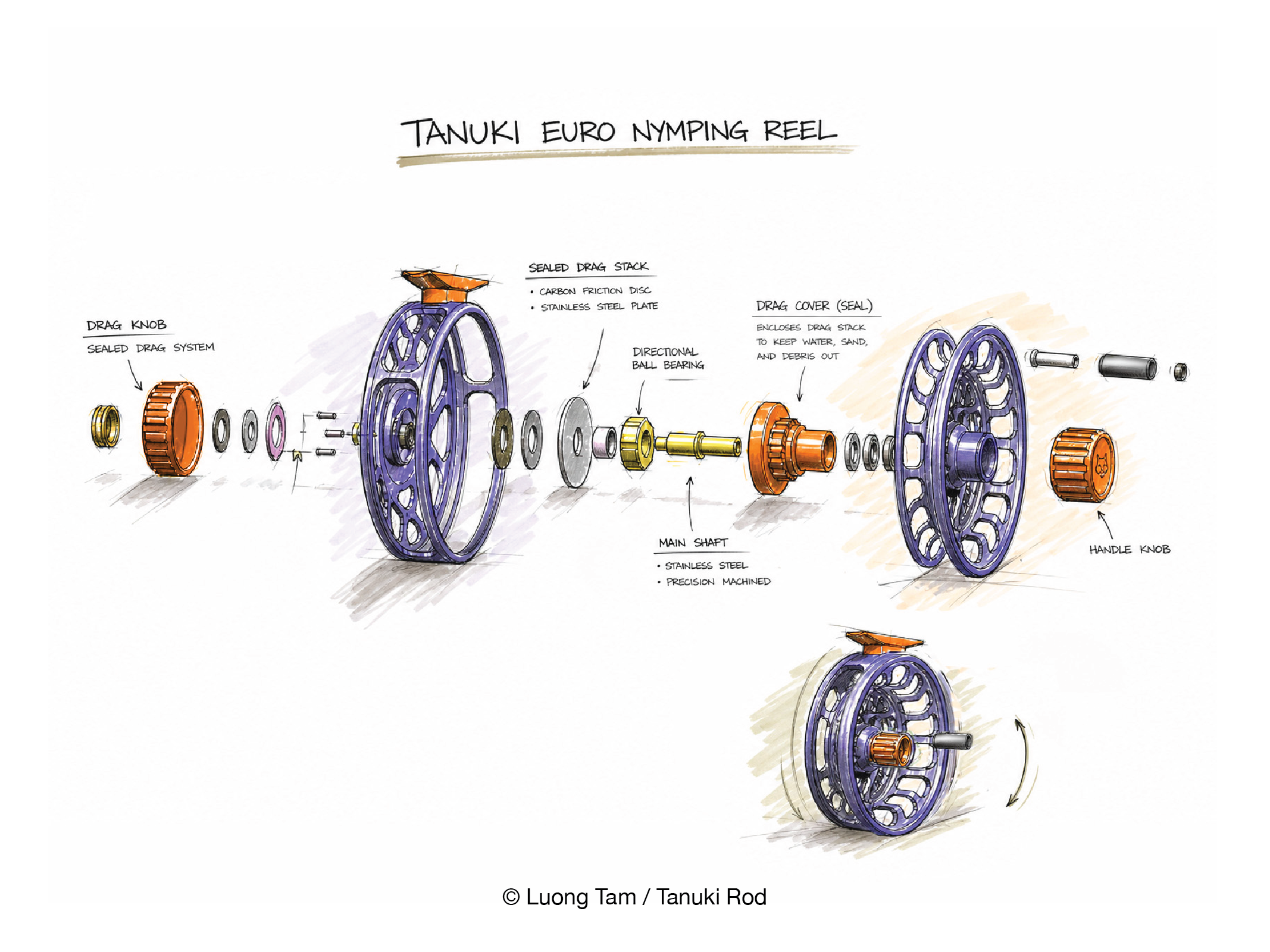
Euro nymphing did not begin as a world separate from fly fishing. It came from fly fishing. Both the euro nymphing rod and reel are rooted in the traditional fly rod and fly reel, but over time each has been refined to better serve a method built on contact, sensitivity, and control.
Like the rod, the reel has gradually taken on its own specialized form. It is designed to handle euro nymphing lines more effectively, improve line control, and better protect fine tippet. The deeper I got into reel development, the more I came to see that the euro nymphing reel is still very much a fly reel—just shaped more deliberately around a specific way of fishing.
At its core, the drag system in a euro nymphing reel is still a modern fly reel disc drag. What makes it different is not that it belongs to a completely separate category, but that it is shaped around the more specialized demands of euro nymphing: managing thin line, protecting fine tippet, and delivering smooth, controlled performance in a highly focused system.
That is why, the more I worked on reel development, the more I realized that drag cannot be looked at by itself. It has to be understood as part of the whole reel design. The frame, spool shape, arbor size, and drag system all work together. In euro nymphing, where precision and line control matter so much, those relationships become even more important.
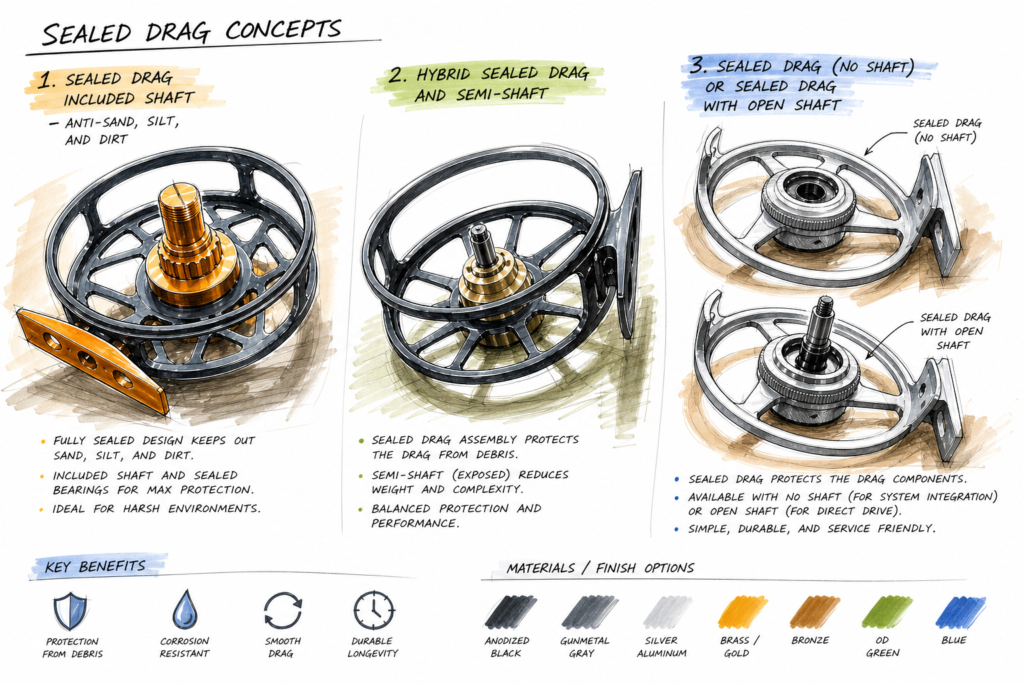
Today, sealed drag systems are commonly used in modern fly reels, but not all sealed systems are the same. There are different levels of sealing, depending on how much of the drag system and shaft are protected.
The most protected design is a fully sealed drag and shaft system. In this design, both the drag discs and the main shaft are enclosed. This helps prevent sand, dirt, and silt from reaching the shaft and drag components. It also reduces maintenance time because less debris can enter the working parts of the reel.
A second design is a partially sealed drag system with a semi-covered shaft. This protects the drag unit better than an open design, but the shaft is still partly exposed. It offers a good balance between protection, cost, and weight, but it is not as resistant to sand, dirt, and silt as a fully sealed shaft system.
The simplest design is a sealed drag with an open shaft, or sometimes an unsealed/open drag system, depending on the construction. This is usually the most economical and lightweight option. The trade-off is that the reel may require more cleaning, maintenance, and lubrication, especially after fishing in sandy, silty, or dirty water.
In general, the more fully sealed the system is, the better the protection. But more sealing usually means more parts, more machining, more cost, and sometimes more weight. Less sealing can make a reel lighter and more economical, but it also places more responsibility on the angler to clean and maintain the reel.
For a euro-nymphing reel, where fine line control and reliability are important, sealing is not only about keeping water out. It is also about keeping sand, silt, and dirt away from the shaft and drag surfaces, so the reel stays smooth with less maintenance.
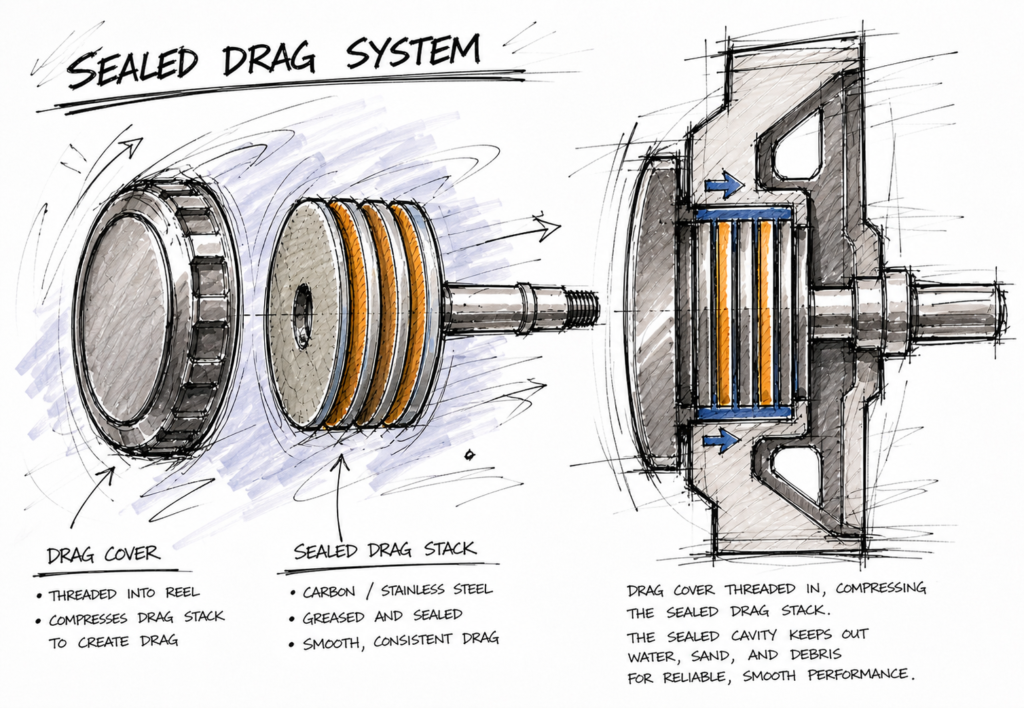
The basic mechanics of a disc drag system are simple. A drag friction disc is sandwiched between two metal plates. When the angler turns the drag knob, the knob increases or decreases pressure on the plates. More pressure creates more friction, and more friction creates more drag.
In this way, the disc drag works much like a brake system.
There are two common layouts: a single-disc drag and a stacked-disc drag. A single-disc system uses one friction disc between two plates. A stacked-disc system uses multiple friction discs and metal plates layered together.
Both systems can provide a good, smooth startup when designed properly. The difference becomes more noticeable as drag pressure increases. A stacked-disc system has more friction surfaces, so the pressure is spread across multiple contact points instead of concentrated on one disc. This can give the drag a smoother feel under higher load, provide stronger drag in a compact space, and help reduce heat buildup during longer runs.
However, a stacked-disc system also has trade-offs. It is usually more expensive to manufacture, can add weight, and requires a higher level of precision. The plates must be flat, evenly finished, and carefully aligned during assembly. If the machining, calibration, or pressure balance is poor, a stacked drag system may not feel smoother than a well-made single-disc system.
For a fly reel, especially a euro-nymphing reel, the goal is not only maximum drag power. The more important goal is smooth startup, controlled resistance, low heat buildup, and protection for fine tippet.
If you are interested in purchasing one of the final approval prototypes before full production, please join the prototype waiting list.