


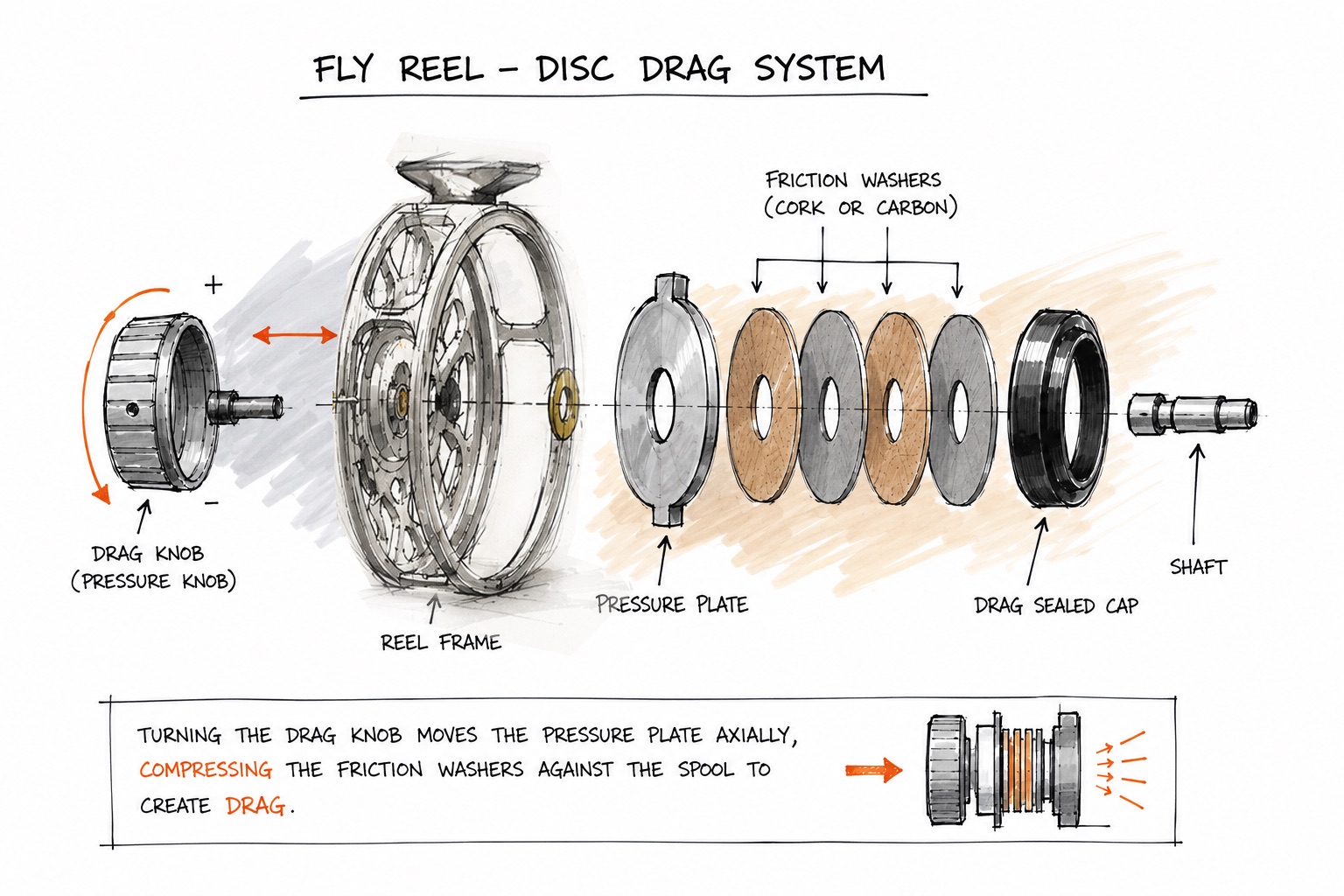
Before comparing cork and carbon drag materials, we first need to define the problem.
A Euro nymphing reel is not designed around long-distance casting or stopping large saltwater fish. It is designed around contact, control, sensitivity, and fine-tippet protection.
Euro nymphing reels are usually used with thin lines, long leaders, and light tippets. The angler is often fishing close to direct contact with the flies, feeling subtle changes through the rod, line, and hand. In this style of fishing, everything matters: reel weight, spool balance, start-up inertia, drag smoothness, and how consistently the reel performs in wet and gritty conditions.
The reel also lives in a rough environment. It is used around water, sand, silt, gravel, mud, and streamside dirt. It may be handled with wet hands, placed on rocks, or exposed to fine particles that can work their way into mechanical parts. For this reason, a good Euro nymphing reel should be smooth, light, consistent, and well protected.
The main job of the drag is simple: protect the fine tippet and allow the fish to take line smoothly when needed. A sudden jump in resistance can break light tippet. A rough or inconsistent drag can reduce confidence when fighting fish. For Euro nymphing, the drag does not need to stop a tarpon, but it does need to start smoothly and remain predictable.
Understanding the Mechanical Drag System
Mechanically, cork and carbon disc drag systems can be very similar. The main difference is the friction material.
The basic pressure path looks like this:
Drag knob → draw bar / screw → pressure plate → friction washer / drag disc → rotating drag plate or spool hub → spool
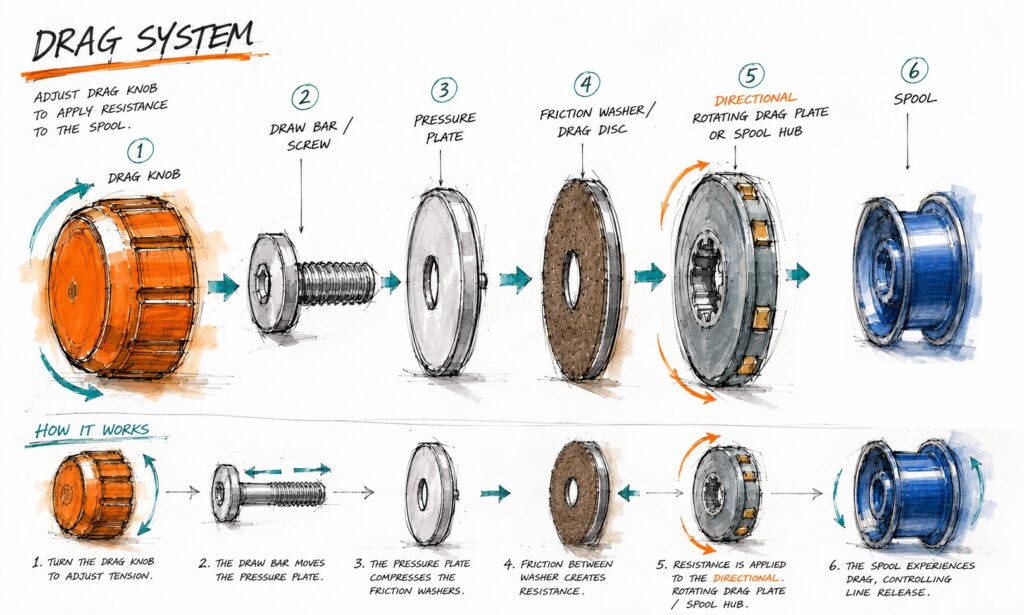
In a draw-bar disc drag system, when the angler tightens the adjustment knob, the screw or draw bar increases pressure inside the drag stack. This pressure pushes the pressure plate against the friction washer and drag plate. The friction created between the metal plate and the friction material controls how freely the spool can turn when a fish pulls line.
In simple terms, the drag system is a controlled brake.
The smoother the transition from a still spool to a moving spool, the better it protects the tippet. The more consistent the pressure, the more predictable the reel feels during a fight.
So the question is not only:
Which material has more stopping power?
For Euro nymphing, the better question is:
Which material gives smooth start-up, low maintenance, consistent performance, fine-tippet protection, and good resistance to water, sand, and silt?
Cork Drag
Cork drag has a long history in premium saltwater and big-game fly reels. Many anglers still view it as one of the classic gold-standard drag materials for powerful fish such as tarpon, permit, bonefish, and other fast-running species.
Cork drag uses cork as the friction material. In high-end reels, this is not ordinary cork. It is usually high-quality compressed or treated cork designed to handle pressure and repeated use. The cork washer is matched with precision-machined metal drag plates so pressure can be applied evenly.
Pros of Cork Drag
The biggest strength of cork drag is its smooth start-up. A well-designed cork drag can transition from a still spool to a moving spool with very little hesitation. This helps reduce sudden shock when a fish makes a hard run, which is especially important when protecting lighter tippet.
Cork also has a naturally progressive feel. Under pressure, it compresses slightly, allowing the drag force to build in a smooth and controlled way rather than feeling abrupt. This gives cork drag the refined feel many anglers associate with classic high-end reels.
Cork also carries a sense of tradition and craftsmanship. For many experienced anglers, cork drag is not only a technical feature. It represents a certain kind of reel-making heritage. A customer who asks for cork drag may be expecting the smooth, powerful, classic feel associated with big-game reels from makers such as Abel or Tibor.
Cons of Cork Drag
The weakness of cork is maintenance.
Cork drag is a little like owning an old Jaguar. It has charm, history, and a beautiful feel, but it rewards the angler who understands maintenance.
Cork usually needs proper lubrication with cork drag grease. When properly greased, adjusted, and cared for, cork can feel wonderfully smooth. But if it dries out, becomes contaminated, or is neglected, it may lose that silky feel.
Cork can also be affected by water, dirt, drying, compression, and long-term wear if it is not cared for properly. In a Euro nymphing reel, this matters because the reel is often exposed to wet hands, sand, silt, mud, and gravel. Fine particles can reduce smoothness and make the drag feel less consistent.
For big-game saltwater reels, many anglers accept the maintenance because cork gives them a classic feel and strong, smooth braking power. For Euro nymphing, the balance is different. The reel is used more often in gritty freshwater environments, and the drag usually does not need extreme stopping power. It needs smoothness, consistency, and reliability with minimal attention.
Carbon Fiber Drag
Carbon fiber drag uses carbon fiber as the friction material. Like cork, it works by creating controlled friction between the friction washer and metal drag plates. The mechanical idea is similar, but the material behavior is different.
Carbon fiber is widely used in modern disc drag systems because it is strong, stable, and resistant to wear. It can perform well under pressure and can be designed into compact, sealed, or semi-sealed drag systems.
Pros of Carbon Fiber Drag
The biggest advantage of carbon fiber is consistency.
Carbon fiber is more stable in wet and dirty conditions than cork. It does not require the same level of lubrication and care. For a Euro nymphing reel, this is important because the reel is often exposed to water, silt, sand, and streamside dirt.
Carbon fiber can also be very smooth when the drag system is well designed. The smoothness does not come only from the carbon material. It also depends on the flatness of the metal plates, the pressure distribution, the machining tolerance, the drag stack design, and the adjustment range.
Carbon fiber also works well in lightweight, modern reel designs. It can provide enough braking force for trout and Euro nymphing without adding unnecessary weight or complexity. For a fine-tippet system, the goal is not maximum drag power. The goal is controlled, predictable resistance.
Another strength is lower maintenance. A carbon drag system can be designed to be more water-resistant and less sensitive to dirt and drying. This makes it practical for anglers who want reliable performance without frequent greasing or adjustment.
Cons of Carbon Fiber Drag
Carbon fiber is not automatically better just because it is modern. A poorly designed carbon drag can still feel rough, grabby, or inconsistent.
If the drag plates are not machined well, if pressure is uneven, or if the drag stack is poorly designed, carbon fiber will not feel smooth. The material alone does not create a good drag system. The whole system must be designed correctly.
Carbon fiber may also lack the classic feel and tradition of cork. Some experienced anglers like the warmer, more progressive feel of cork. Carbon fiber can feel more mechanical or modern, depending on the design.
Another possible weakness is that some carbon drag systems can have slightly more start-up feel than a perfectly tuned cork drag. But in a well-designed modern reel, this can be minimized through proper material choice, surface finish, pressure plate design, and drag adjustment range.
Comparing Drag Smoothness
After looking at the strengths and weaknesses of both materials, the next question is how each drag feels through the adjustment range.
The smoothness chart above is a conceptual comparison between cork and carbon fiber drag systems. For this example, assume the drag knob rotates from 0 degrees to 540 degrees, or about one and a half turns.
At 0 degrees, there is no drag pressure. At 540 degrees, the system reaches maximum pressure or near lock-up.
In this simplified comparison, cork drag builds pressure in a more linear and predictable way through most of the adjustment range. The pressure increases steadily as the knob turns. This gives cork a very consistent relationship between knob rotation and drag pressure.
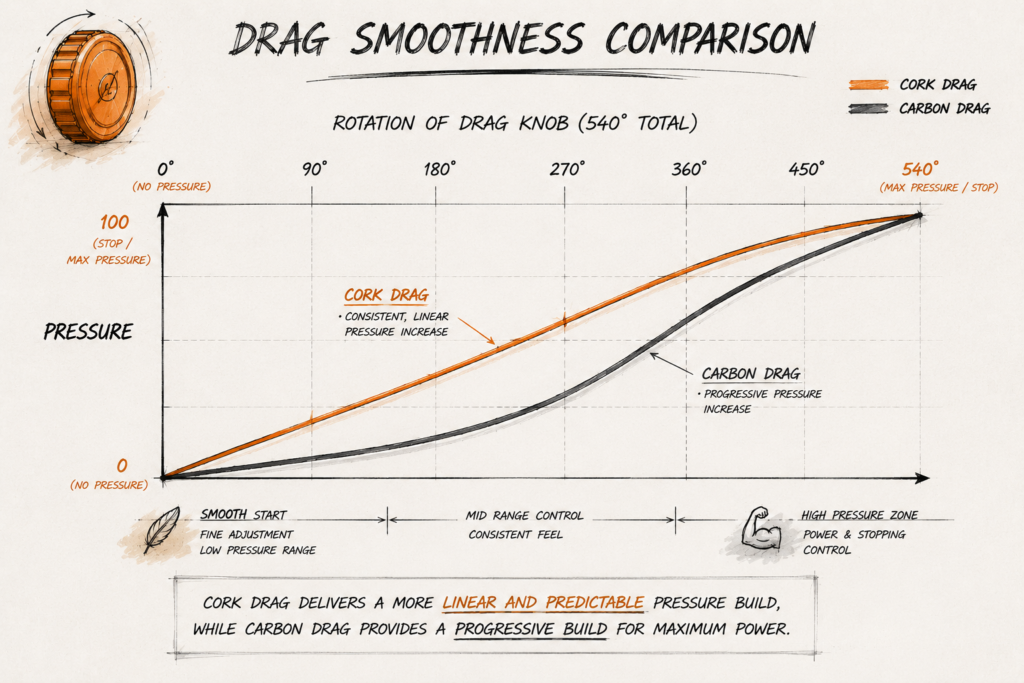
Carbon fiber drag can feel very smooth in the lower and middle range, especially when the drag stack is well designed. Depending on the thread pitch, pressure plate design, washer material, surface finish, and drag geometry, carbon may build pressure more progressively. It may feel lighter at first, then increase more quickly from the mid-range into the higher-pressure zone.
For fine-tippet Euro nymphing, this can be useful. Most trout fishing happens in the lower-to-middle drag range, where the reel needs to start smoothly, protect light tippet, and allow controlled line release. In that practical working range, a well-designed carbon fiber drag can give the smoothness and control needed without requiring the extreme stopping power of a big-game reel.
This does not mean cork is always smoother or carbon is always more powerful. It means cork drag may feel more consistent in relation to drag knob rotation, while carbon fiber drag may build pressure more progressively, especially from the mid-range into the high-pressure range.
In both cases, the final drag feel is controlled by the whole mechanical system, not only by the friction material. Thread pitch, pressure plate design, washer material, surface finish, machining tolerance, and drag geometry all affect how the drag feels in the hand and performs on the water.
Cork vs. Carbon for Euro Nymphing
For Euro nymphing, the drag system should be judged by the fishing method, not by tradition alone.
Cork drag is beautiful, classic, and proven. It has a smooth, progressive feel and a long history in premium big-game reels. But it requires more care. It needs grease, adjustment, and protection from contamination. It is best for anglers who appreciate traditional reel craftsmanship and are willing to maintain it.
Carbon fiber drag is more practical for a modern Euro nymphing reel. It offers consistency, durability, lower maintenance, and better resistance to water, sand, and silt. When properly designed, it can provide the smooth start-up and controlled resistance needed to protect fine tippet.
In Euro nymphing, the reel does not need to stop a powerful saltwater fish. It needs to manage thin line, protect fine tippet, and perform smoothly in a wet, gritty freshwater environment. That changes the design priority.
Summary
Cork drag and carbon fiber drag can use a similar mechanical system. Both rely on pressure, friction washers, and metal drag plates to control spool movement. The difference is how each material behaves under pressure, moisture, dirt, and long-term use.
Cork drag is classic, smooth, progressive, and admired by many experienced anglers. Its weakness is maintenance. It works best when properly greased, adjusted, and cared for.
Carbon fiber drag is modern, stable, durable, and lower maintenance. Its performance depends heavily on good engineering, precise machining, and even pressure distribution.
For a Euro nymphing reel, I would choose carbon fiber drag.
Not because cork is bad, but because Euro nymphing demands a drag system that is smooth, light, consistent, water-resistant, dirt-resistant, and easy to maintain. Carbon fiber better matches those needs.