


Tenkara 101 should stay at the conceptual level. The goal is not to overwhelm the beginner with too much technical detail, but to help them understand why the rod matters and how it works within the tenkara system.
In Western fly fishing, the rod is designed around casting a dynamic length of line. The fly line has weight, and that line weight loads the rod during the cast. The angler can also change the amount of line outside the rod tip.
Tenkara works differently.
A tenkara rod is designed around a fixed line length. There is no reel and no extra running line to shoot through the guides. Because of this, reach comes mostly from the rod length, the line length, and the angler’s position. If the angler needs more reach, the rod itself often needs to be longer.
The tenkara rod is the heart of the system. It gives the angler reach, control, casting rhythm, and a direct connection to the fly. In tenkara, the rod is not just a tool for casting. It is also part of the presentation, the hook set, and the way we control and land fish.
This section introduces the basic structure of a telescopic tenkara rod, including the collapsed length, sections, tip, lillian, grip, and overall balance. It also explains rod length and action in a simple way, showing how softer and stiffer rods feel different during casting and while fighting fish.
We will also look at the simple physics behind how a tenkara rod works: how it flexes, stores and releases energy, creates leverage, protects light tippet, and gives the angler a sense of swing feel in the hand.
Finally, this section will help beginners choose their first rod—one that is easy to cast, comfortable to fish, forgiving, and suitable for the type of water they fish most.
Topics Covered
1. Understanding the Telescopic Rod
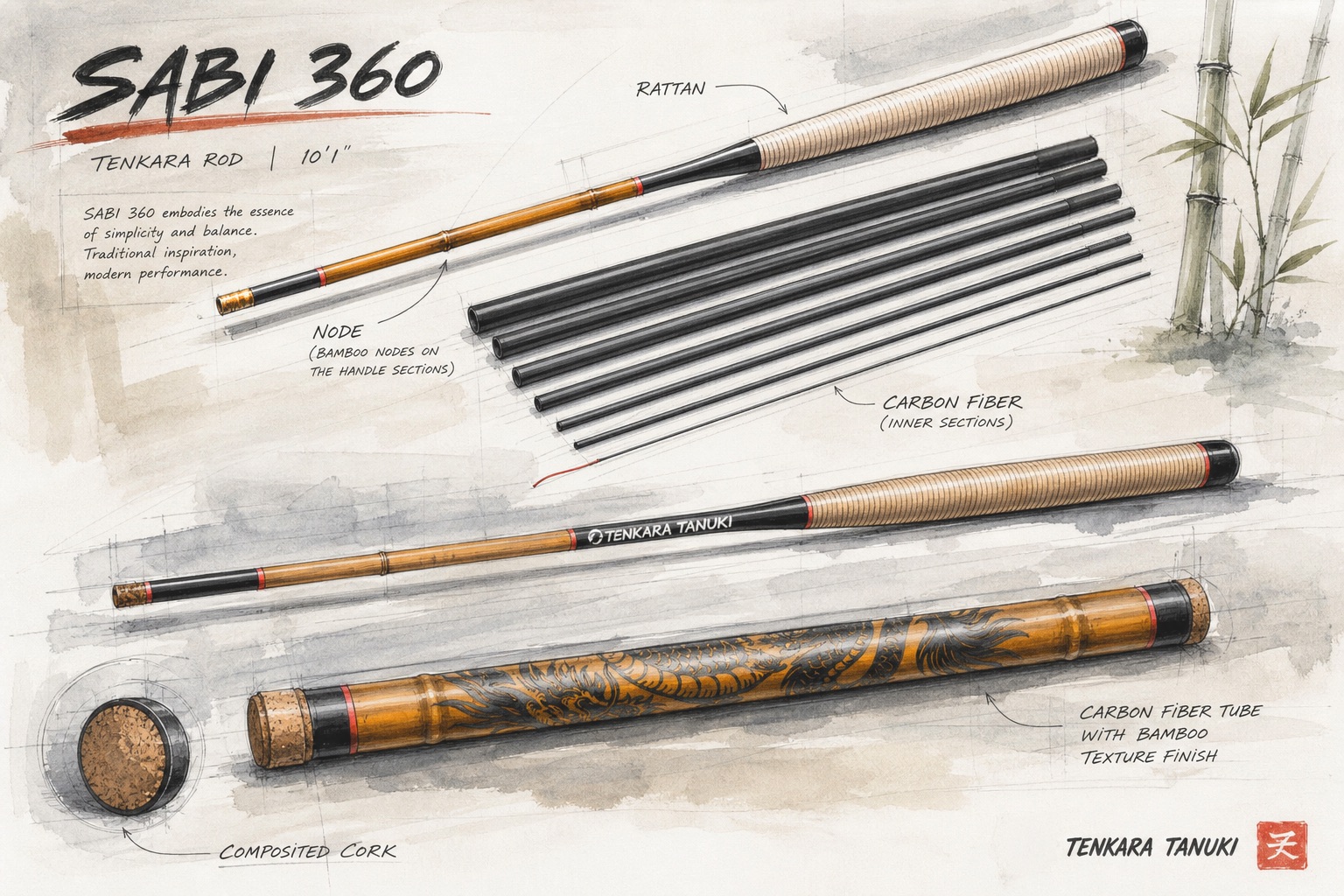
A tenkara rod is a telescopic rod. This means each section slides inside the next larger section when the rod is collapsed. When the rod is extended, the sections lock together through friction, creating one long, flexible fishing rod.
In the Japanese rod system, the sections are usually numbered from the tip toward the handle. The very tip section is Section #1. Attached to the end of this tip is a short braided cord called the lillian, which is where the tenkara line connects. From there, the sections are counted down toward the grip and handle section.
When tenkara was introduced to the United States, Tenkara USA used the reverse section numbering system: the handle section is Section #1, and the rod tip is the last section. At Tenkara Tanuki, I keep the Japanese section numbering system to respect the origin of the rod design.
Each rod section is shaped like a very long, thin cone. The smaller diameter points toward the rod tip, and the larger diameter points toward the handle. This tapered shape allows each section to slide into the next larger section, but also prevents it from passing completely through.
Near the bottom of each section, there is usually a short area of unfinished carbon, often about two to three inches long. This unfinished surface helps increase friction so the sections hold together when the rod is extended.
Older Japanese tenkara rods often had much longer handle sections. For example, an 11-foot rod might have had a collapsed length of around 38 inches. Today, because carbon materials, mandrel design, and manufacturing technology have improved, some modern tenkara rods can collapse much shorter. Some compact rods may have handle sections around 12 inches long.
But shorter collapsed length comes with a trade-off.
For the same full rod length, a shorter collapsed rod needs more sections. More sections mean more overlapping material, more reinforced areas, and often a steeper taper between sections. This can make the rod heavier, stiffer, and less smooth in casting feel. It may also create more air resistance because the rod has more step changes in diameter along its length.
A longer collapsed rod is usually less convenient to pack, but it can often feel smoother, lighter, and more refined in casting. A shorter collapsed rod is easier to carry in a backpack or travel bag, but it may sacrifice some performance.
So rod design is always a balance between convenience and performance. A compact rod is easier to transport. A longer-collapsed rod may offer better casting feel, smoother flex, and lighter swing weight. Neither is automatically better. The right choice depends on how and where you fish.
Multi-Length Rods
In the 1990s and early 2000s, Japanese rod makers introduced 2-way and 3-way rods. These rods could be fished at more than one length. Later, in the United States, similar rods became commonly known as zoom rods or multi-length rods.
Multi-length rods are convenient because one rod can cover different fishing situations. But there is also a compromise. Compared to a fixed-length rod, a multi-length rod often has less refined balance and performance. Japanese anglers eventually found that while these rods are useful, many serious anglers still prefer the feel of a dedicated fixed-length rod.
As a rod maker and designer, I believe the most important quality of a rod is balance. After balance comes responsiveness, sensitivity, ergonomics—especially for longer rods—and finally rod action.
Many anglers begin by asking about rod action first. But in my view, action is only one part of the story. A rod can have the “right” action number and still feel poor in the hand if the balance is not right.
2. Rod Action
Like many anglers, tenkara anglers often pay close attention to rod action. But rod action can also be one of the most misunderstood parts of choosing a rod.
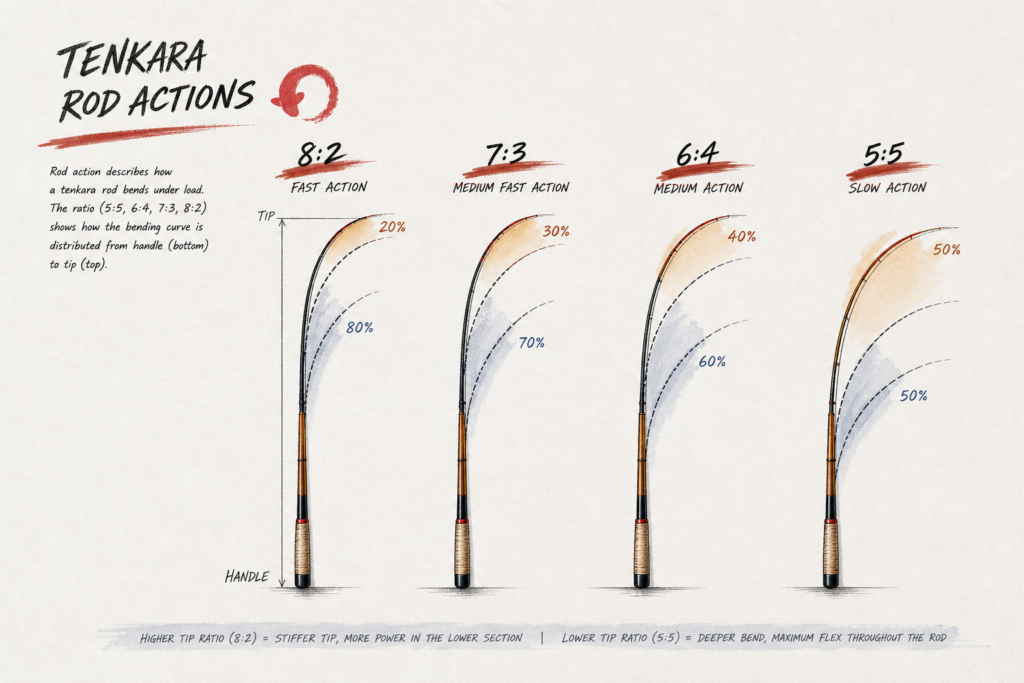
In the Japanese system, rod action is often described with numbers such as 5:5, 6:4, 7:3, or 8:2. These numbers describe where the rod bends during casting. A 5:5 rod bends closer to the middle of the rod. A 6:4 rod bends slightly above the middle. A 7:3 or 8:2 rod bends more toward the tip.
This bending is not just a static shape. It happens during casting motion. As the rod moves through the air, the rod experiences resistance. The rod flexes, stores energy, and then releases that energy to cast the line. Where the rod bends most gives us a general idea of its action.
Rod action also depends on the angler’s casting stroke. A slow, smooth casting stroke may make the rod bend deeper. A quicker, shorter stroke may make the same rod feel faster and more tip-oriented. This is why two anglers may describe the same rod differently. The rod has its own design, but the angler’s motion brings that design to life.
A shorter rod has less length available to bend. Because of this, it is harder to create a true soft 5:5 action in a rod shorter than about 10 feet. If a short rod is made very soft, it may need longer flexible sections, or it may begin to feel too soft and unstable—what some anglers call a “noodle rod.”
Longer rods are different. A longer rod has more room to bend, so it is easier to create a deeper flex. But there is also a trade-off. If a rod longer than about 12 feet has a very deep 5:5 action, the swing weight can increase dramatically. More of the rod’s working mass moves farther from the hand, making the rod feel heavier during casting.
A slower-action or softer rod often feels easier and more relaxed to cast. It bends deeper, loads with less effort, and gives the angler a smooth feeling during the cast. This can be very enjoyable, especially when fishing at close range or when using a gentle casting stroke.
But a softer rod also has limitations. It may be less accurate, especially when casting into wind or trying to place the fly precisely. It can also be harder to control larger fish, especially in fast water. This becomes more noticeable with longer rods, where a slow action can increase swing weight, slow recovery, and make the rod feel less balanced in the hand.
A faster-action rod bends more toward the tip and usually recovers more quickly. It can make casting more precise and gives the angler better control when fishing a longer rod or when fighting fish in faster current. A faster rod can also help move the line and fly more directly.
But faster rods have their own trade-off. Because they bend less deeply, they may place more torque on the hand during acceleration. They can also feel less forgiving if the casting stroke is too aggressive or abrupt. With a faster rod, the angler may feel more direct contact between the hand, the rod, and the fish—but that also means mistakes can transfer more quickly through the system.
So rod action is not simply about choosing soft or stiff. It is about how rod length, taper, section design, material, casting stroke, water condition, fish size, and balance all work together. A good rod action should match the length of the rod and the purpose of the fishing.
The best action is not the softest or the stiffest. It is the one that gives the angler control, feel, and confidence on the water..