
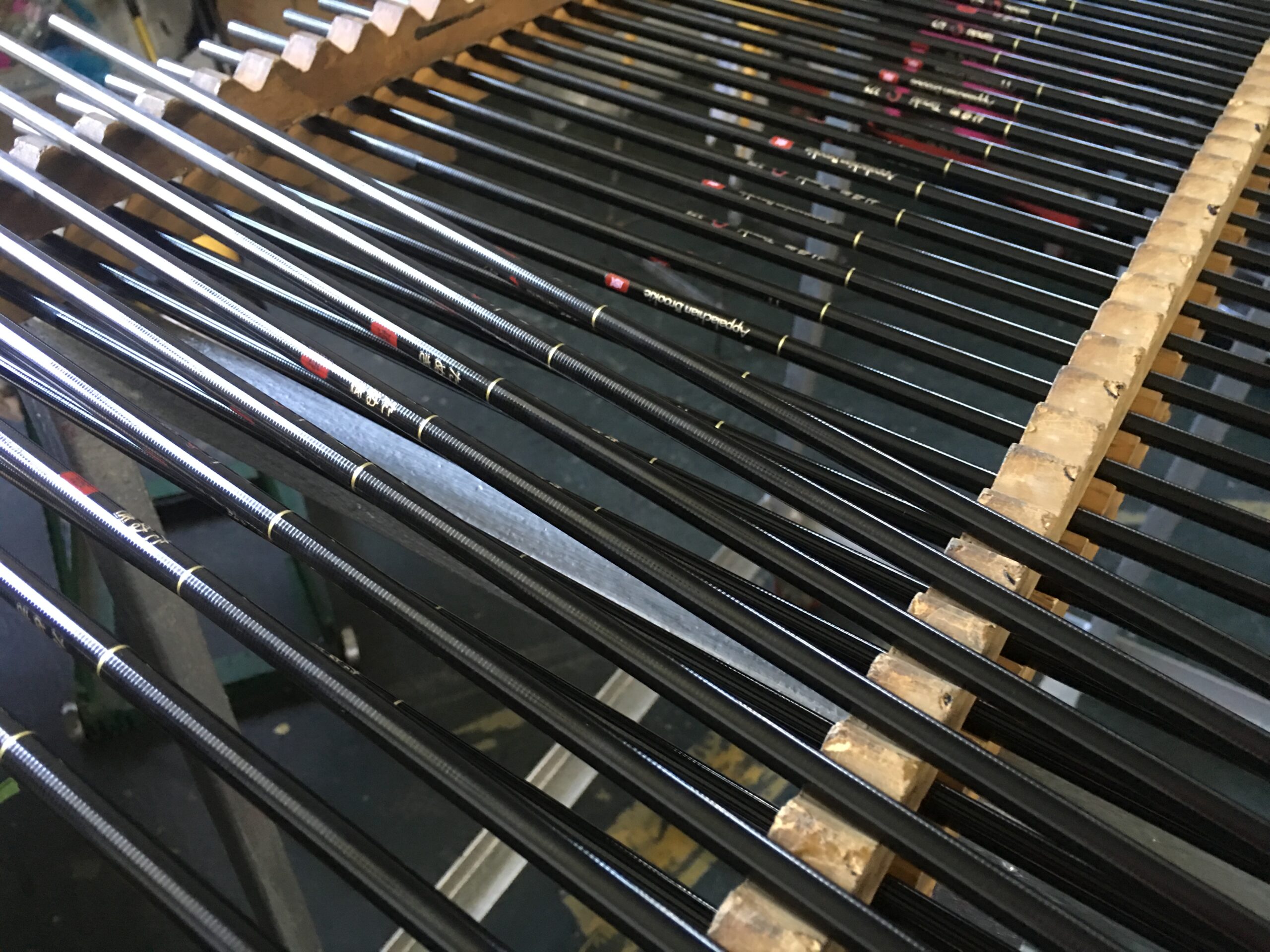
From kitchen prototypes to the first finished rods
After the prototypes were completed, my excitement quickly shifted to the next challenge: finding a rod maker who could help turn these experiments into real rods.
Thanks to the internet, the entire world suddenly sat on my desktop.
Unfortunately, none of the rod makers in the United States were interested in building a small run of prototypes. Some quoted prices that were simply out of reach. Others required long lead times—six months at minimum—along with large upfront deposits. At the same time, Japanese and Taiwanese rod builders weren’t interested in prototype work either. Many preferred to sell existing designs or tell me what they thought was best for me.
I wasn’t looking to be sold a rod.
I was looking for someone willing to build one with me.
I searched through countless listings on platforms like Alibaba. Most factories wanted to push what they already had in stock. Others were unwilling to deviate from their standard designs.
Then I found a small rod maker in China with a very different response.
“Tell us what you want,” they said. “We’ll do our best.”
That was all I needed to hear.
I explained that I wanted to go through at least three rounds of prototypes, each built to my specifications. Their response was straightforward:
“No problem—we’ll send you the PI options.” (PI stands for Purchase Invoice.)
The standard turnaround time for a prototype was about four weeks. If I wanted it completed in less than two weeks, the cost would double. I chose speed—I couldn’t wait to see the first result. Even at double the cost, a two-week turnaround, combined with international shipping via FedEx, was still faster and more practical than any other option I had explored.
The first batch arrived quickly: three prototype rods, each built with different materials. This allowed me to closely inspect carbon quality, construction consistency, and overall craftsmanship.
After extensive casting-pond evaluation, I selected Toray 46T high-modulus carbon, approximately equivalent to what is commonly labeled IM12. Tonnage (T) refers to tensile modulus—higher values indicate stiffer fibers—but modulus alone does not define rod performance. IM ratings, by contrast, are manufacturer-defined and non-standardized.
Compared to lower-modulus materials, Toray 46T offered reduced mass, faster recovery, and higher responsiveness. The trade-offs are increased material cost and a narrower flex envelope, both of which were acceptable within the intended design parameters.
See the table below for an approximate Tonnage (T) to IM comparison.
IM Rating vs. Tonnage — Approximate Equivalents
| IM Rating | Approximate Tonnage Equivalent |
| IM6 | ~24T |
| IM7 | ~30T |
| IM8 | ~36T |
| IM10 | ~40T |
| IM12 | ~46T |
The second round of prototypes focused on improving flexibility and refining craftsmanship. I worked directly with the factory’s rod engineer, and to speed up the process we conducted strength tests and live rod-bend curve evaluations over Skype. This approach saved both time and shipping costs.
By early February 2015, ten final rods were delivered with a simple label: Fatmonk 360 (360 cm). Ten rods were enough for me—to fish extensively and to gift to a few close fishing friends.
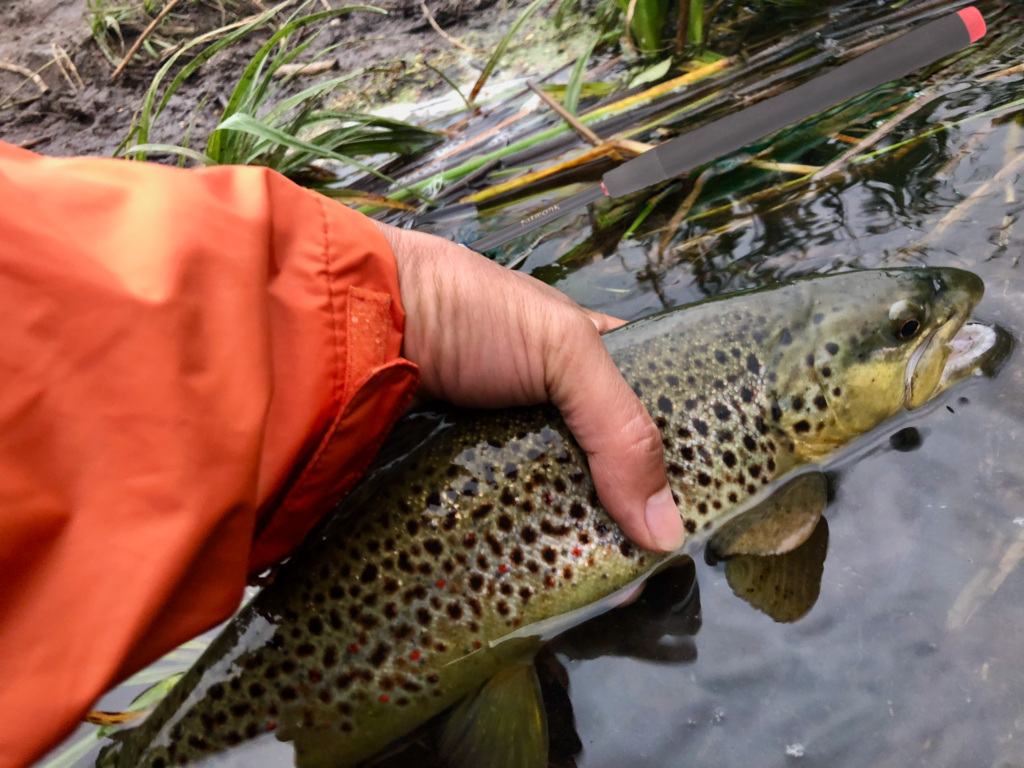
I was thrilled.
It was time to go fishing.
Around that time, Hideto Ed Yoshida, president of the Tokyo Fly Fishing Club, flew over to visit. I took him fishing with the new rod.
After a few casts, he turned to me and said,
“This is the best Tenkara rod I’ve fished. Casting level line with your rod is hard to beat. It’s perfect for both nymphing and kebari.”
I thanked him for the compliment, but part of me wondered if he was simply being polite. To be sure, I asked,
“Do you think I should change anything if I commercialize the rod?”
“No,” he replied. “Leave it alone. It’s perfect—for me.”
That was when I knew his feedback was genuine.
For the first time, I felt real confidence—not just in the rod, but in the journey that led to it. I couldn’t wait to put it into more hands and see what others felt.